


Rocker switches are common electrical switches used in everyday life, widely applied in various devices and industrial equipment.
From household appliances to automotive dashboards and control panels, rocker switches offer a simple and intuitive way to control circuits.
Their robust and durable construction, ease of operation, and clear on/off indicators make them a popular choice across many industries.
This article will explain what a rocker switch is, it’s working principle, different types and internal structures, common applications, and answer frequently asked questions.
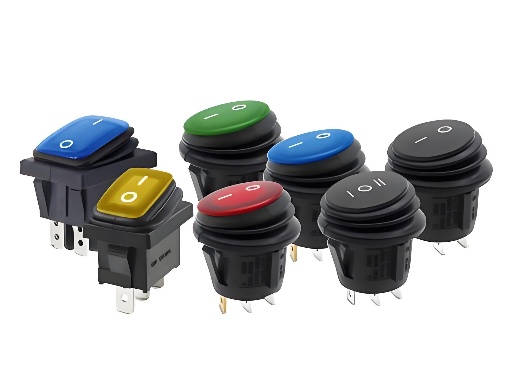
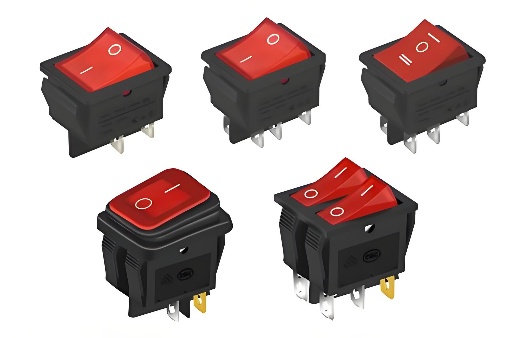
A rocker switch is a type of electrical switch that operates by rocking back and forth on a pivot point. Pressing one side of the switch turns a circuit on, while pressing the opposite side turns it off.
This rocking motion gives the switch its name and makes its operation visually and physically clear.
Most rocker switches are maintained switches, meaning they stay in their selected position until manually changed.
This is different from momentary switches, which return to their default state after being released.
Rocker switches are commonly labeled with symbols such as “I” and “O” to indicate on and off positions, making them easy to identify even without text.
Rocker switches are available in a wide range of sizes, electrical ratings, and mounting styles. They can be panel-mounted or integrated directly into enclosures, making them suitable for both consumer products and industrial equipment.
How does A Rocker Switch Work?
Rocker switches have a simple and reliable mechanical structure. Inside the switch is a movable contact connected to an external actuator.
Pressing one side of the toggle switch moves the internal contact, thus connecting or disconnecting the circuit.
In a typical rocker switch, pressing the “on” side makes the internal contacts engage, allowing current to flow through the circuit.
Pressing the other side separates the contacts, stopping the current flow. The switch remains in that position until the user presses the other side again.
Some rocker switches use a spring and snap-fit mechanism, which provides a secure switching action and helps ensure consistent contact pressure.
This design reduces contact wear and improves electrical reliability over time.
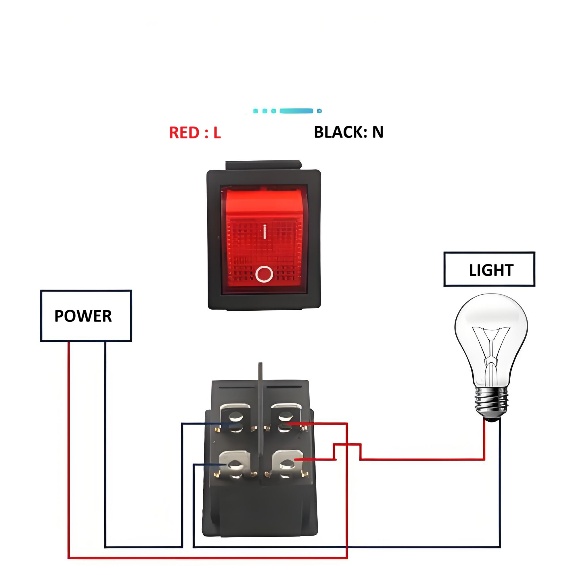
For rocker switches with indicator lights, an internal indicator light, usually an LED or neon light is connected to the circuit. When the switch is in the “on” position, the indicator light illuminates, helping the user quickly check the switch status in low-light environments.
Types of Rocker Switches and Structure
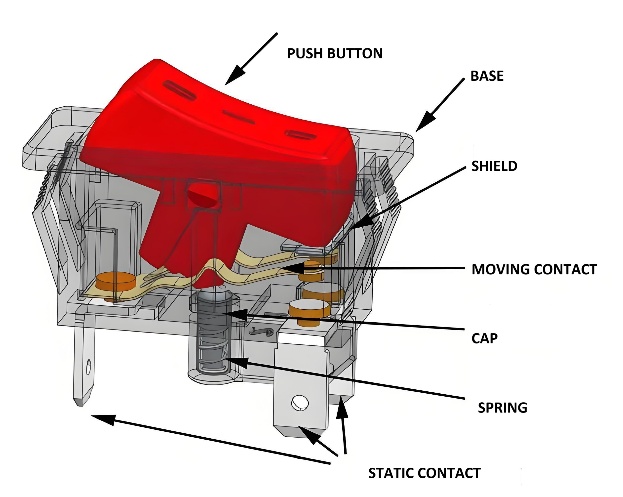
Rocker switches come in many variations to suit different electrical and environmental requirements.
Understanding these types can help narrow down the right option for a specific application.
By Function
- On-Off Rocker Switch: The most common type, used to control power to a device or circuit.
- Momentary Rocker Switch: Returns to its default position when released. Often used for control functions rather than power switching.
- On-Off On Rocker Switch: Has three positions, commonly used for direction control or mode selection.
By Illumination
- Non-Illuminated Rocker Switch: Relies on physical position or labelling to indicate status.
- Illuminated Rocker Switch: Includes an internal light to show whether the circuit is active. Common in automotive, marine, and industrial panels.
By Environment and Rating
- Marine Rocker Switch: Designed with sealing and corrosion resistance for moisture-prone environments.
- Industrial Rocker Switch: Built for higher current ratings and frequent operation.
- Low-Voltage Rocker Switch: Used in electronics and control circuits.
Internal Structure
Most rocker switches consist of:
- A rocker actuator
- Internal contacts
- A spring or pivot mechanism
- Terminals for wiring connections
- Optional illumination components
This structure allows for a balance between mechanical durability and electrical performance.
What Are Rocker Switches Used For?
Rocker switches are used across a wide range of industries because they are easy to operate and visually intuitive.
Household and Consumer Products
Rocker switches are commonly found in power strips, coffee makers, heaters, and small appliances.
Their clear on/off indication makes them ideal for everyday use.

Automotive and Marine Applications
In vehicles and boats, rocker switches control lighting, fans, auxiliary power, and accessories.
Illuminated and marine rocker switches are especially popular in dashboards where visibility and moisture resistance matter.

Industrial Equipment
Control panels, machinery, and power tools often rely on rocker switches for main power control or mode selection.
Their robust construction supports frequent operation in demanding environments.

Electronics and Power Supplies
Rocker switches are widely used in AC power inlets, power adapters, and test equipment, where a maintained on/off function is required.
Medical and Laboratory Devices
Some medical and lab instruments use rocker switches for equipment power control, benefiting from their stability and ease of cleaning.
Conclusion
Due to their ease of operation, clear visual feedback, and applicability to a variety of applications, toggle switches remain a widely used switching solution. Whether used in household appliances, vehicles, industrial equipment, or electronic devices, toggle switches provide reliable circuit control with minimal user intervention.
Bituo Electric offers a range of options to meet functional and environmental requirements, from standard on/off toggle switches to versions with lighting and marine grades. Some switches have protection ratings of IP67, IP55, or IP54, depending on the switch series.
Rocker Switch FAQs
Q How is a rocker switch different from a toggle switch?
A rocker switch rocks back and forth on a pivot, while a toggle switch uses a lever that moves up and down. Both serve similar functions, but rocker switches often provide clearer visual indication.
Q Are rocker switches latching or momentary?
Most rocker switches are latching, meaning they stay in position until pressed again. Momentary rocker switches are available for specific control applications.
Q What is an illuminated rocker switch?
An illuminated rocker switch includes a built-in light that indicates the switch status, making it easier to see whether a circuit is on or off.
Q Can rocker switches handle high current?
Some rocker switches are designed for higher current ratings, but the exact capability depends on the switch specifications. Always match the switch rating to the application.
Q How do you wire a rocker switch?
Rocker switch wiring depends on the switch type and circuit design. Common terminals include line, load, and ground, with additional terminals for illumination if present.