


You flip a switch on your dashboard to turn on the fog lights. You press a rocker on your power strip to cut power to your desk setup. You tap a panel switch on a piece of factory equipment to start a conveyor belt. All three use the same basic component: the rocker switch.
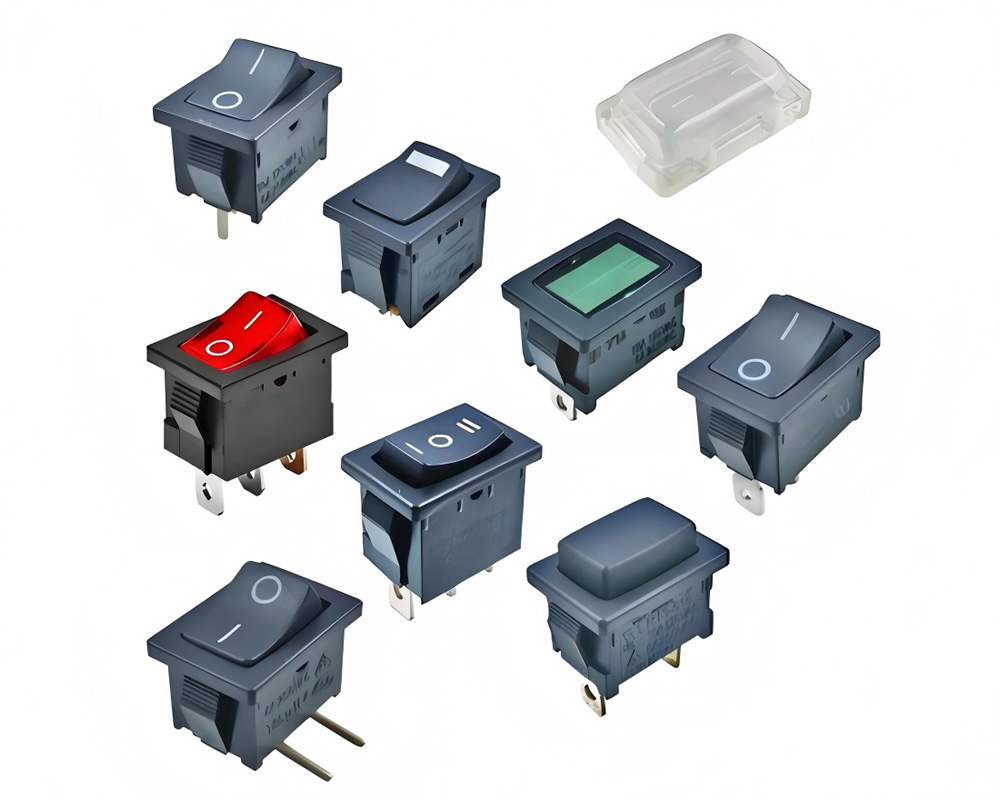
Bituoelec manufactures a broad range of rocker switches for automotive, marine, appliance, and industrial applications. This guide walks through how they work, what types are available, and how to wire and select the right one.
What Is a Rocker Switch and How Does It Work
A rocker switch is a panel-mount switch with a pivoting actuator that rocks back and forth between two positions. Press one side and the circuit closes. Press the other and it opens. Inside, a spring-loaded contact mechanism snaps between the terminals when the actuator crosses its center point.
The rocking motion gives the operator a clear tactile and often auditory click, so there is no guesswork about whether the switch engaged. The actuator surface is typically curved or slightly textured for grip. The switch body sits behind the panel, held in place by snap-in clips or a threaded bezel with a locking nut.
Types of Rocker Switches: SPST, SPDT, DPST, DPDT
SPST (Single Pole Single Throw)
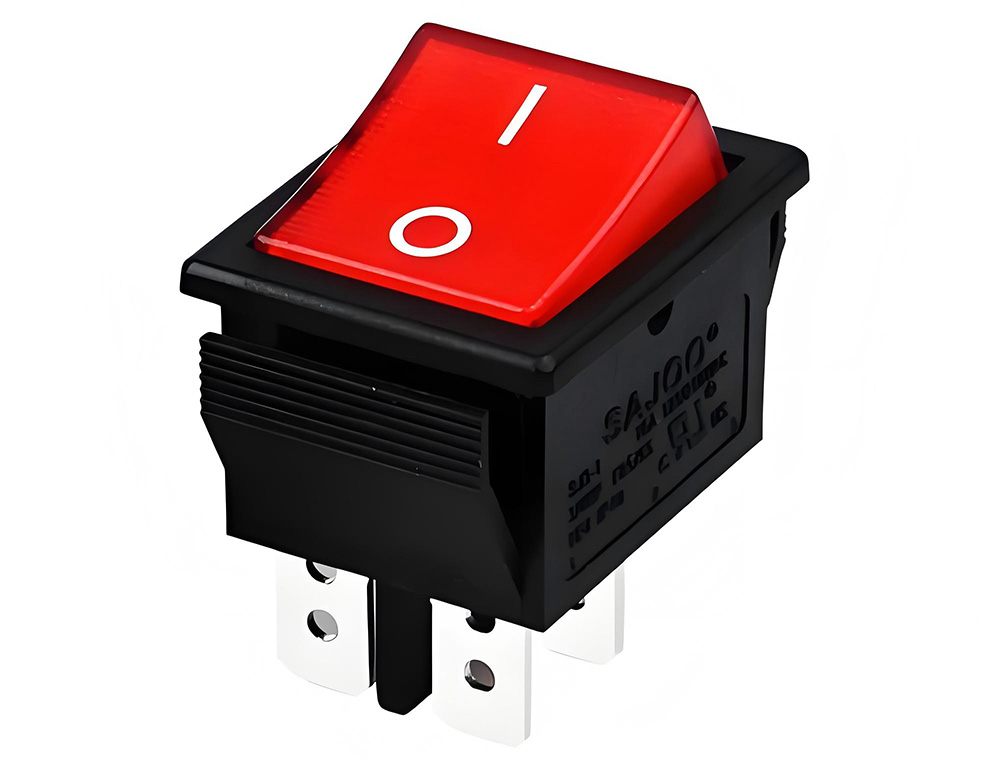
The simplest type. Two terminals. On and off. One circuit. Most power switches on appliances and power strips are SPST rocker switches. Press one side to turn on, the other to turn off.
SPDT (Single Pole Double Throw)
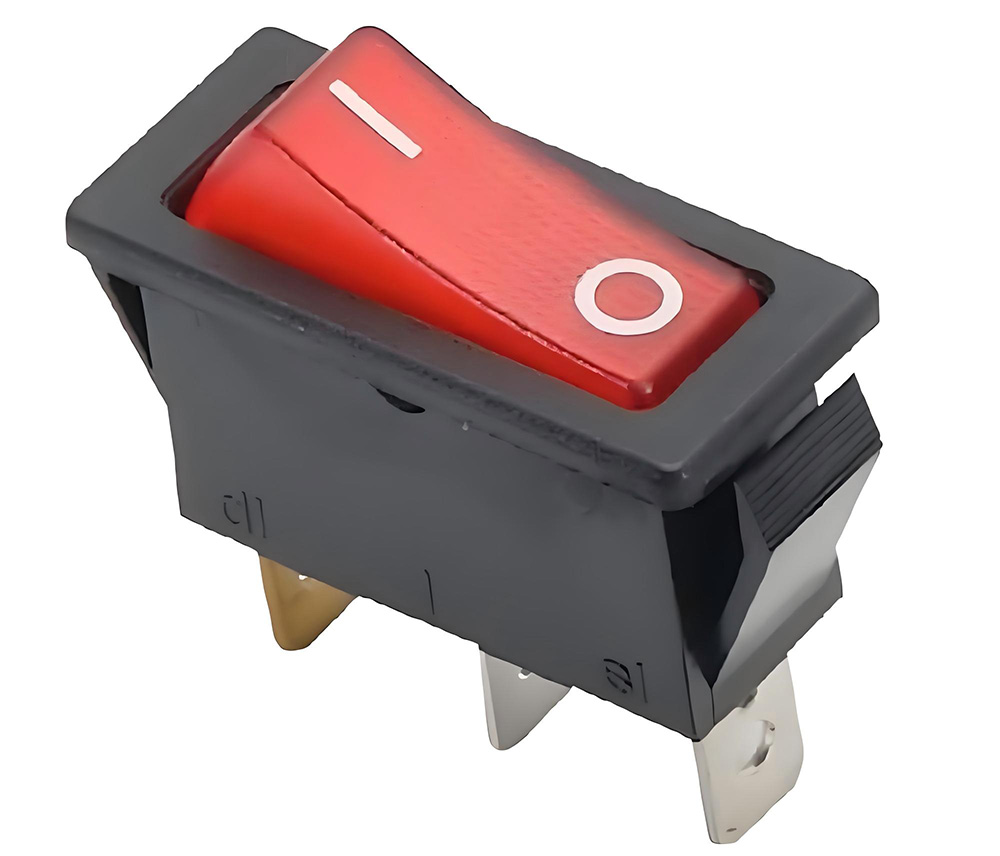
Three terminals. One input can connect to one of two outputs. This is the switch you use when you want a single rocker to toggle between two circuits, such as switching between two light sources or routing a signal to one of two paths.
DPST and DPDT
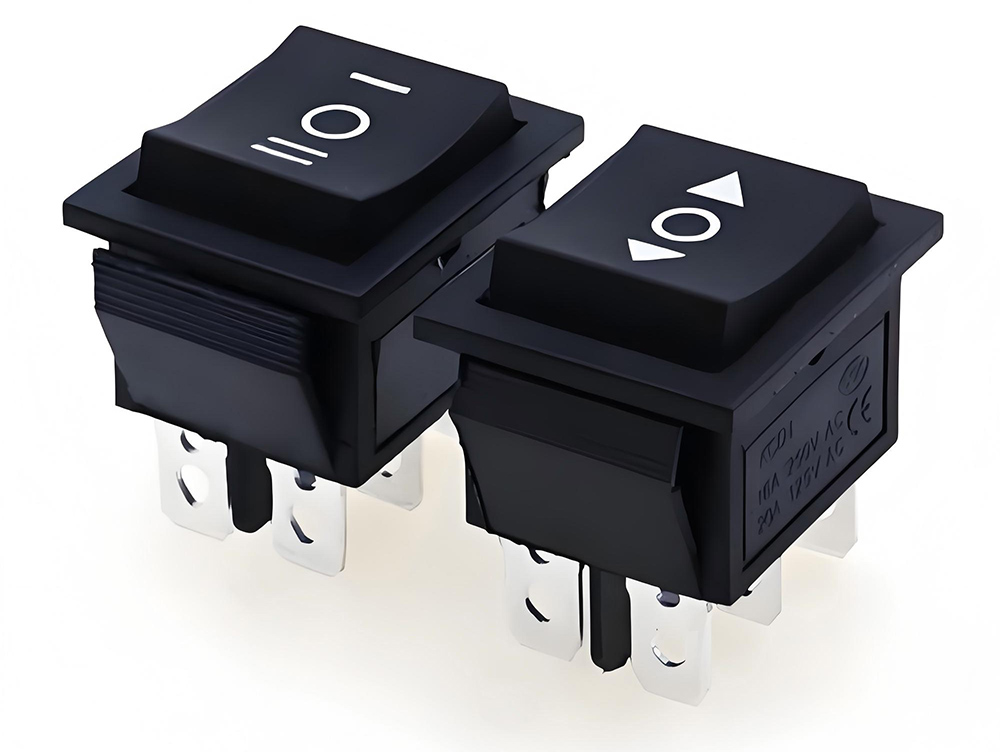
DPST (double pole single throw) switches two separate circuits on and off simultaneously with one rocker. Four terminals. DPDT (double pole double throw) switches two circuits between two output paths each. Six terminals. These are common in industrial control panels where one switch needs to control two independent loads at the same time.
Illuminated vs. Non-Illuminated: LED Options Explained
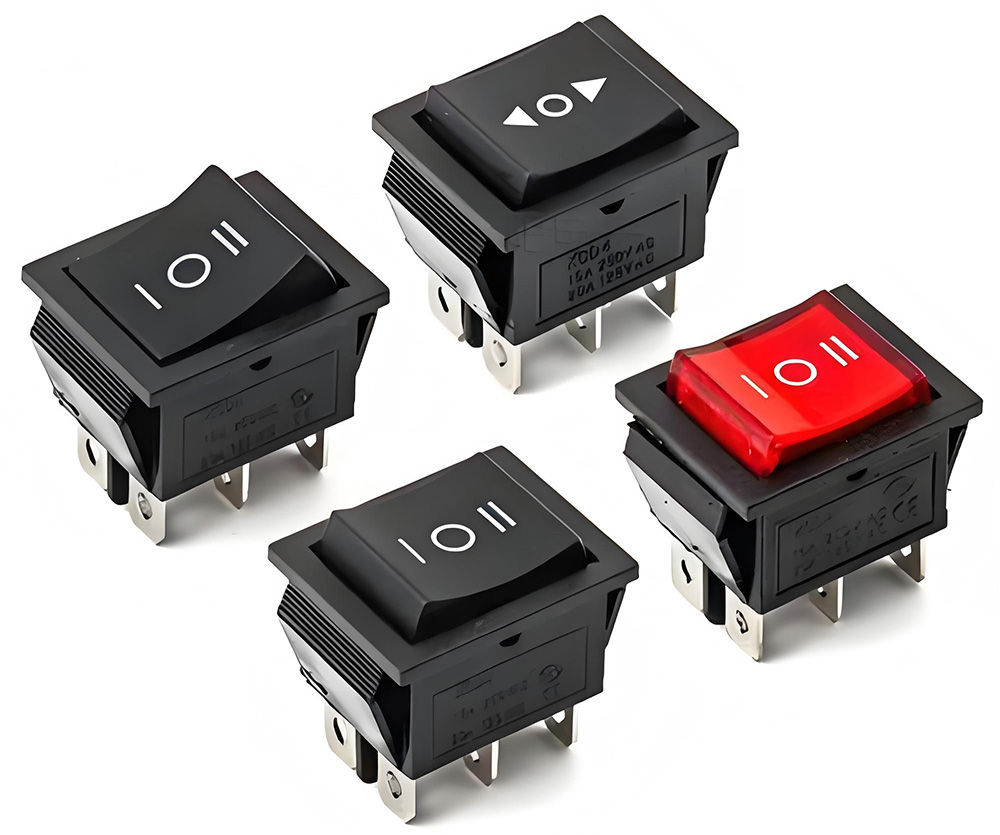
An illuminated rocker switch has a built-in LED that lights up when the switch is in the on position, or in some designs, stays lit whenever power is present so the switch is visible in the dark. The LED can be wired to the switch’s load circuit or powered independently. Common LED colors are red, green, blue, amber, and white.
The LED voltage needs to match the circuit voltage. A 12V LED will not work on a 24V circuit without a resistor. Some illuminated rockers include a separate LED pin for independent control. Non-illuminated rockers are simpler and cost less. They work fine for applications where a visual indicator is not needed or the equipment has its own status lights elsewhere.
Momentary vs. Latching: Choosing the Right Action
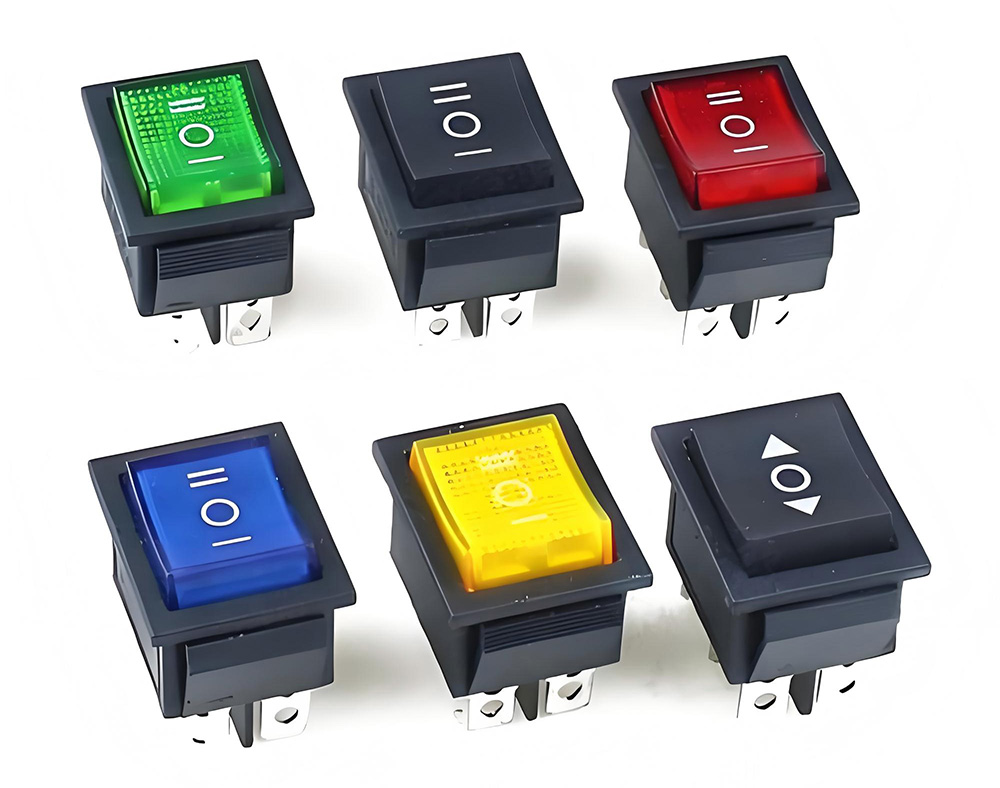
A latching rocker switch stays in the position you set it. Press one side for on and it stays on. Press the other side for off and it stays off. This is what you want for a power switch or a mode selector. A momentary rocker switch springs back to its center position when released.
Use this for horn buttons, engine start switches, and jog controls on machinery where the action should only last as long as you hold it. Some rocker switches are available in a three-position configuration: on-off-on, with the center position as the resting state and momentary action in one or both directions.
Key Electrical Specifications to Check
Voltage and Current Rating
Rocker switches are typically rated for 10A to 20A at 125VAC or 250VAC. A switch marked 16A at 250VAC might handle 20A at 125VAC but only a few amps at 12VDC. The DC rating is always lower because DC arcs do not self-extinguish at the zero-crossing point like AC does. If your circuit runs on DC, even at 12V or 24V, check the DC rating specifically.
Contact Resistance and Insulation
Contact resistance should be under 50 milliohms for a new switch. Higher contact resistance means more heat at the switch under load, which shortens switch life and can be a fire risk in high-current circuits.
Insulation resistance, measured between terminals and between terminals and the switch body, should be at least 100 megohms at 500VDC. Dielectric strength, the ability to withstand voltage spikes without internal arcing, is typically 1500VAC for one minute.
Wiring Basics: Pin Configurations and Connection Tips
2-Pin and 3-Pin Wiring
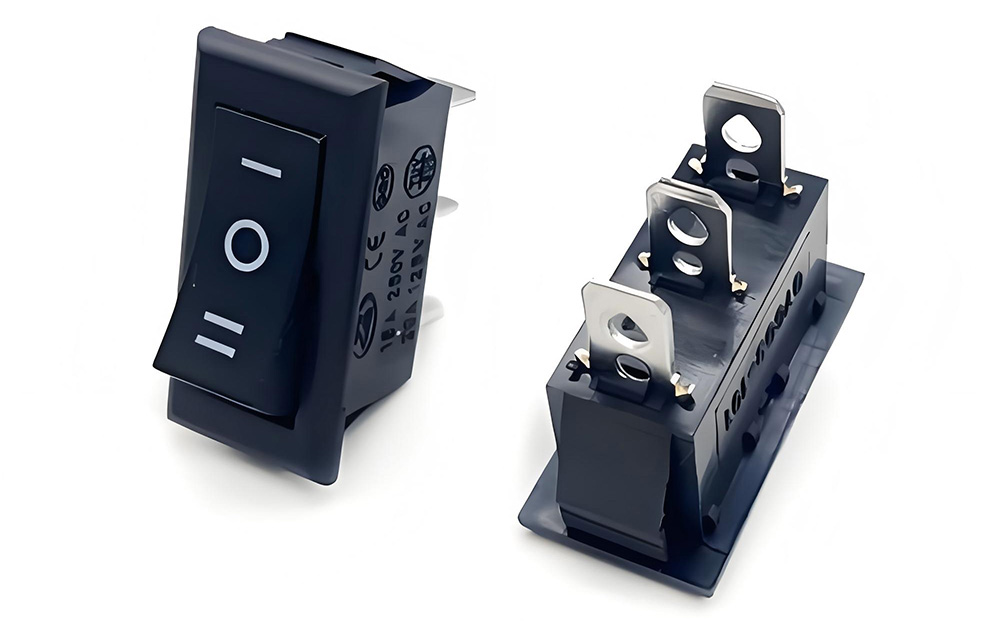
A 2-pin rocker switch is the simplest: one pin to the power source, the other to the load. The switch simply connects or disconnects the circuit. A 3-pin rocker adds an LED indicator. Two pins are for the switched circuit and the third is a ground or neutral for the LED.
Some 3-pin rockers wire the LED in series with the load so it only lights when the switch is on. Others wire it across the input so it stays lit as long as power is present.
5-Pin and 6-Pin Wiring
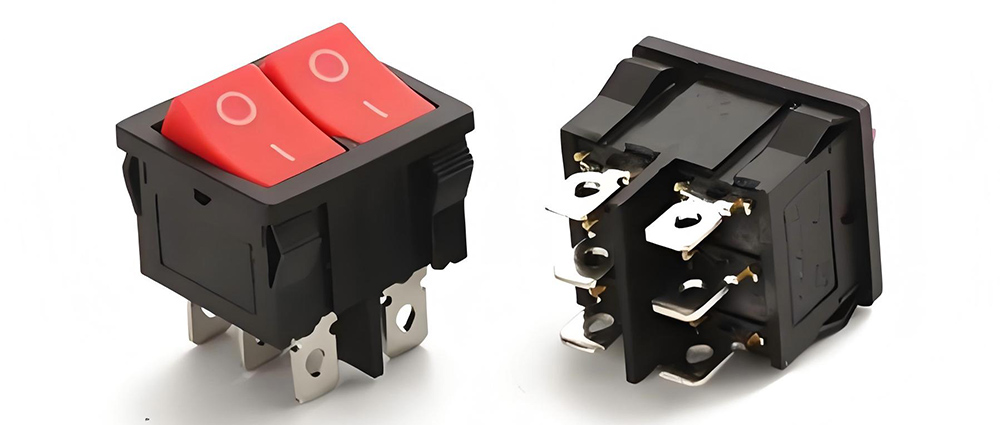
A 5-pin rocker typically has an independent LED. Two pins handle the switch circuit, two handle the LED power, and one is a shared ground. This lets the LED operate independently of the switched load. A 6-pin rocker is usually a DPDT configuration with two independent circuits under one actuator.
Each circuit gets its own common, normally open, and normally closed terminal. Label the wires before you disconnect anything. Use crimp terminals instead of soldering directly to the switch pins when possible. Crimp connections are faster to assemble and easier to service later.
Waterproof and IP-Rated Rocker Switches
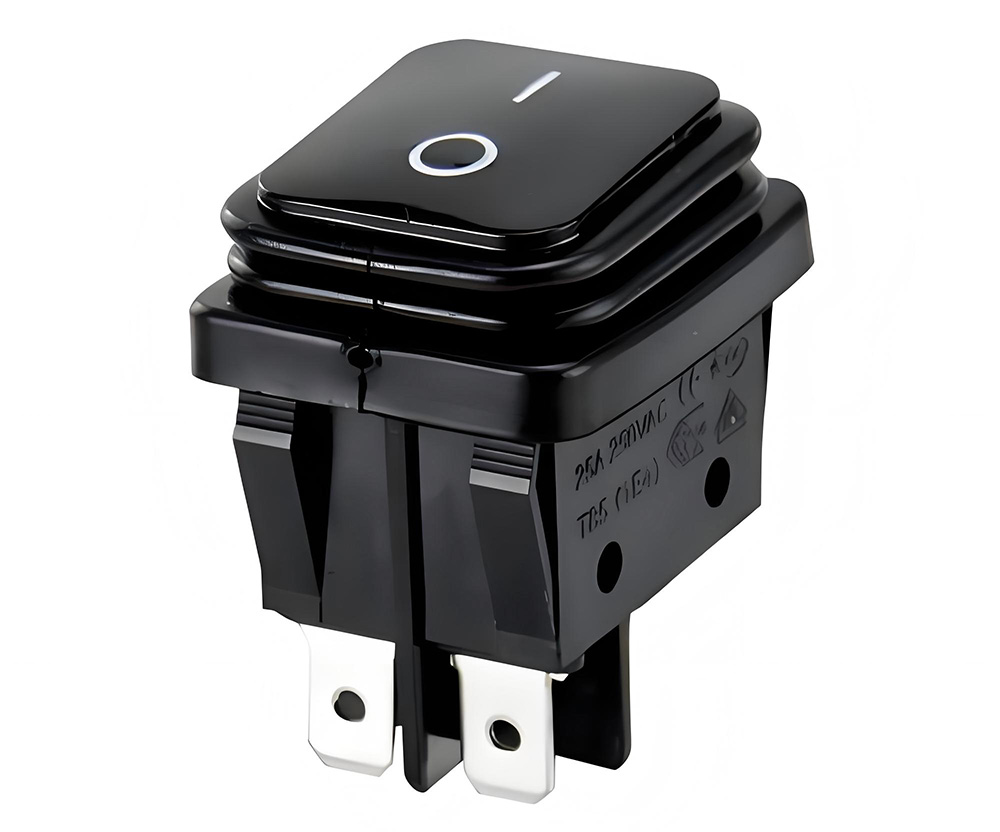
Standard rocker switches are not sealed. Water or dust that gets behind the panel can reach the contacts and cause corrosion or short circuits. For outdoor, marine, or industrial washdown environments, choose an IP-rated rocker switch.
An IP65 rating means the switch is dust-tight and protected against low-pressure water jets. IP67 means it can survive temporary immersion.
These switches use a flexible silicone or rubber boot over the actuator and sealed terminals at the back. The rubber boot gives the rocker a softer feel than a hard plastic actuator. Some panel-mount designs include a gasket between the switch bezel and the panel surface. Make sure the gasket is seated flat before tightening the mounting nut.
Common Applications Across Industries
Automotive dashboards use rocker switches for fog lights, auxiliary lighting, winch controls, and accessory power. Marine panels use IP-rated rockers for bilge pumps, navigation lights, and horn controls, where salt spray and moisture are constant threats.
Home appliances like space heaters, coffee makers, and air purifiers use SPST rockers as the main power switch. Industrial control panels use DPDT rockers where one switch needs to toggle two separate circuits. RVs and camper vans use illuminated rockers on their control panels so the switches are easy to find in the dark.
How to Select the Right Rocker Switch for Your Project
Start with the circuit. How many poles and throws do you need? One circuit on-off: SPST. One circuit switching between two paths: SPDT. Two circuits switching together: DPST. Two circuits with two outputs each: DPDT. Then pick maintained or momentary action. Next, check the voltage and current.
Match the switch rating to the load. If the load is inductive, like a motor or a coil, derate the switch by 30 percent because inductive loads cause bigger arcs at the contacts. Choose illuminated if the operator needs visual feedback.
Choose IP-rated if the switch sees moisture or dust. Select the panel cutout size: common sizes are 12mm x 19mm, 15mm x 21mm, and 22mm x 30mm. Match the terminal type to your assembly method: quick-connect tabs for fast production, solder lugs for low volume, or screw terminals for field wiring.
See Bituoelec rocker switch product line for a full range of SPST, SPDT, DPST, DPDT, illuminated, and IP-rated options.
Installation Tips and Troubleshooting
Panel Mounting
If the switch body has snap-in clips, push it straight into the cutout until you hear the clips click. If it has a threaded bezel, slide the switch through the front, thread the locking nut onto the back, and tighten by hand plus a quarter turn.
Do not overtighten. For IP-rated switches with a rubber gasket, hand-tighten only. Over-tightening distorts the gasket and breaks the seal.
Common Problems and Fixes
- Switch feels loose: the mounting clips or nut are not fully seated. Remove and reseat.
- LED does not light: check the LED voltage against the circuit voltage. A 12V LED on a 5V circuit will not light. A 12V LED on a 24V circuit will burn out unless a resistor is in series.
- Switch gets warm during use: the current is too close to the switch rating. Replace with a higher-rated switch or reduce the load.
- Rocker sticks in one position: debris may have gotten into the actuator gap. Clean with compressed air. If the switch has been exposed to sugary drinks or other sticky liquids, replace it. Cleaning the internal mechanism is usually not practical.
Bituoelec Rocker Switch Solutions
Bituoelec manufactures rocker switches in SPST, SPDT, DPST, and DPDT configurations with illuminated and non-illuminated options. IP65 and IP67 waterproof versions are available for marine and outdoor use.
Every switch is tested for consistent actuation force, contact resistance, and electrical life. Custom actuator colors, LED colors, laser engraving, and wiring harnesses are available through OEM and ODM services.
FAQ
Q What is the difference between SPST and SPDT?
SPST has two terminals and controls one circuit on/off. SPDT has three terminals and can switch one input between two outputs. Use SPST for simple power switching. Use SPDT when you need to toggle between two circuits with one switch.
Q Can I use a 12V rocker switch on a 24V system?
The switch contacts may handle the voltage, but check the rating. A switch marked 16A at 250VAC can switch 24VDC but at a much lower current, typically 2A to 5A. If the switch has a built-in LED, the LED voltage must match the circuit. A 12V LED on 24V will burn out unless you add a current-limiting resistor.
Q What does on-off-on mean on a rocker switch?
It means the switch has three positions. The center position is off. Press one side to turn on circuit A. Press the other side to turn on circuit B. Neither circuit stays on without holding if the switch is momentary.
Q Do I need an IP-rated rocker switch for my boat?
Yes. Marine environments have salt spray, high humidity, and occasional direct water contact. An IP65 or IP67 rocker switch with a rubber boot and sealed terminals will last much longer than a standard switch. Standard rockers in a boat can corrode inside within months.
Q How do I know which pin is which on a rocker switch?
Most rocker switches have markings on the body or a printed data sheet. If not, use a multimeter in continuity mode. For a 3-pin switch, two pins will show continuity when the switch is in one position. The third pin is usually the LED ground or neutral. For a 6-pin DPDT, test each set of three pins separately.
Q Where can I buy rocker switches in quantity?
Bituoelec supplies rocker switches in standard and custom configurations with competitive bulk pricing. Contact us with your specifications for a quote.