


You press a button to start your coffee maker. You press another to stop a conveyor belt on a factory floor. You press a third to ring a doorbell. All are push button switches. They are among the most common electrical components in the world, and they come in far more variations than most people realize.
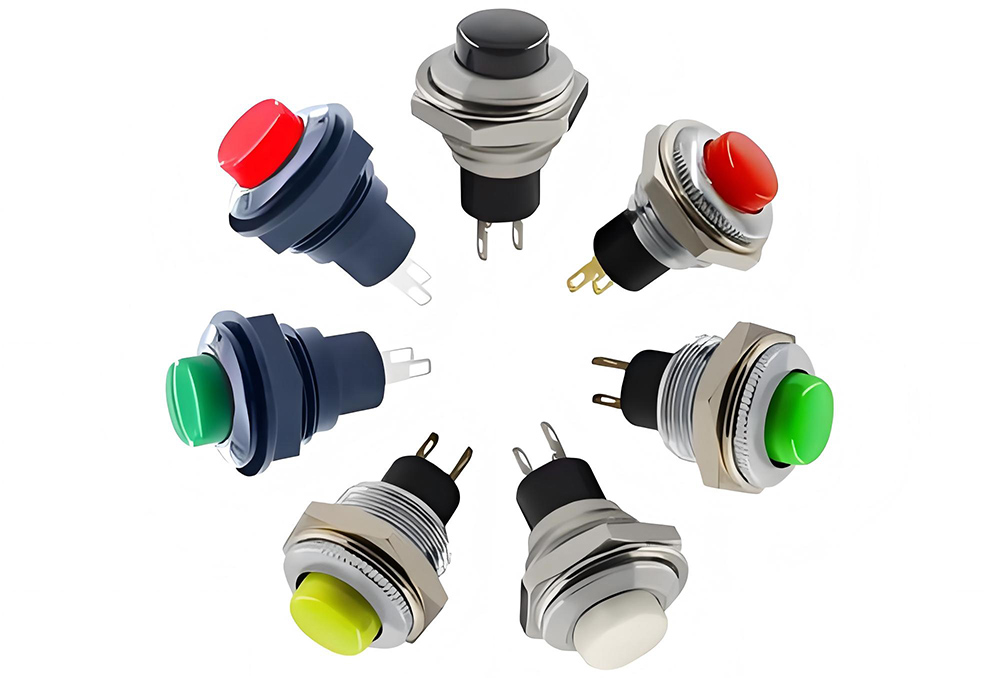
Bituoelec manufactures push button switches in a wide range of sizes, materials, and configurations for consumer, industrial, and outdoor applications. This guide covers the types, how they work, and what to look for when you need to order.
What Is a Push Button Switch and How Does It Work
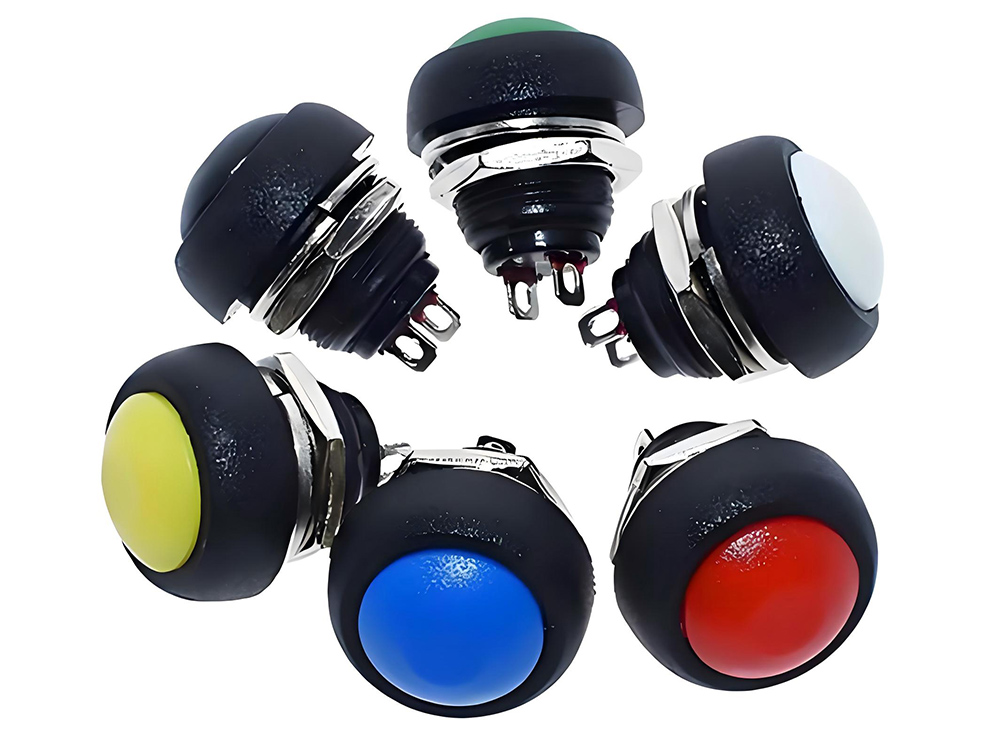
A push button switch is an electrical switch that changes its contact state when you press its actuator. Press the button and internal contacts either connect or disconnect. Release it and a spring returns the actuator to its starting position.
Some types stay in the pressed state until pressed again. Inside, the mechanism is typically a spring-loaded plunger that bridges two fixed contacts when compressed. The travel distance is short, often just one to three millimeters.
The actuation force can range from a light touch of about 100 grams-force for a miniature tactile button up to several kilograms for a heavy-duty industrial mushroom head switch.
Momentary vs. Latching: Understanding Switch Action
Momentary Action
A momentary push button only stays active while you hold it down. Release it and the contacts spring back to their default state. This is what you want for a doorbell, a machine jog button, a horn, or a reset button. The circuit is engaged only during the press. Most push buttons in consumer electronics and industrial control are momentary.
Latching Action
A latching push button clicks into position and stays there. Press once to turn on and the button stays down. Press again to turn off and it pops back up. Use latching for power switches where you do not want to hold the button continuously.
Audio equipment, test bench power supplies, and some industrial panel lights use latching push buttons because the operator needs a persistent visual and mechanical indication of the switch state.
Push Button Shapes and Styles: Round, Square, Mushroom Head
Round and Square Actuators
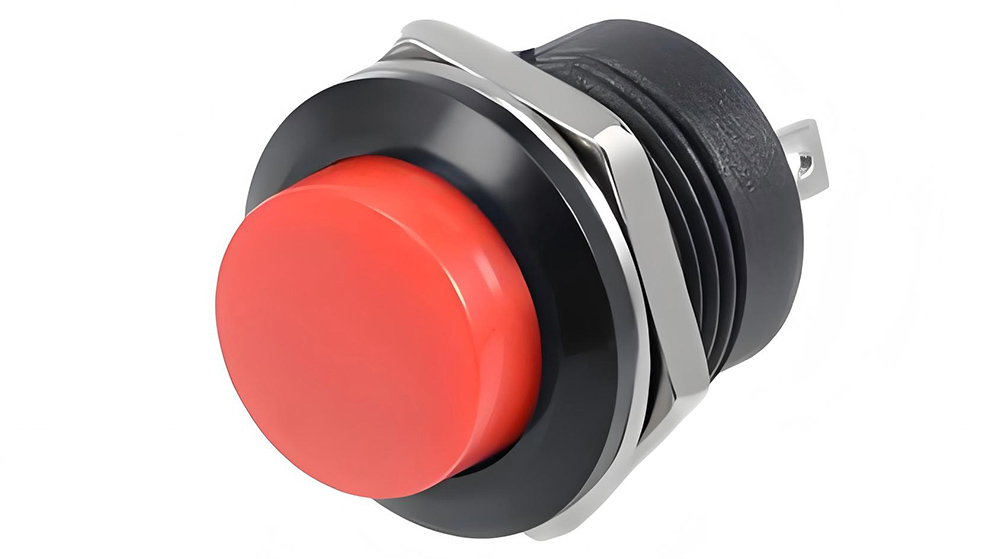
Round push buttons are the most common. They fit standard panel cutouts from 8mm to 30mm in diameter. Square actuators use the same internal mechanism but have a square cap that gives a different look and can be easier to press with a gloved hand.
Square buttons are common on public-facing equipment like elevator panels and ticket machines where appearance matters.
Mushroom Head and Emergency Stop
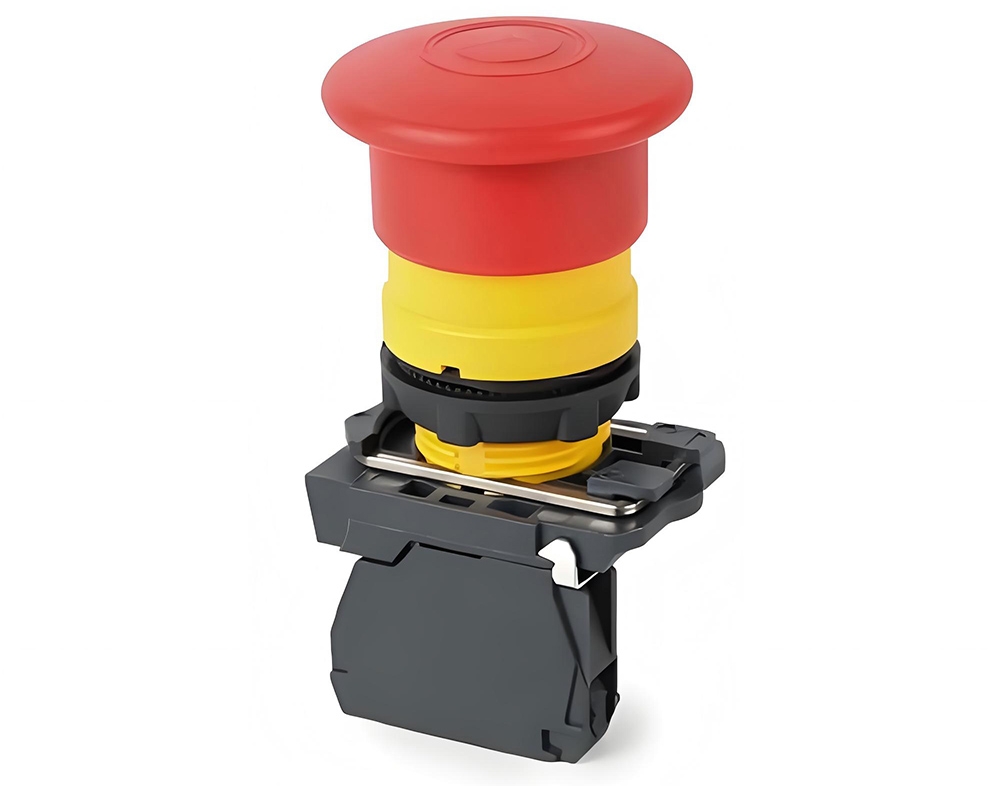
A mushroom head push button has a large, domed actuator that extends beyond the mounting bezel. It is designed to be hit quickly with a palm or fist in an emergency. Emergency stop buttons are almost always mushroom head, red, and latching.
They need a deliberate twist or pull to reset so the machine cannot restart by accident. The large surface area makes them easy to find and strike under stress.
Illuminated Push Buttons: LED Options and Wiring
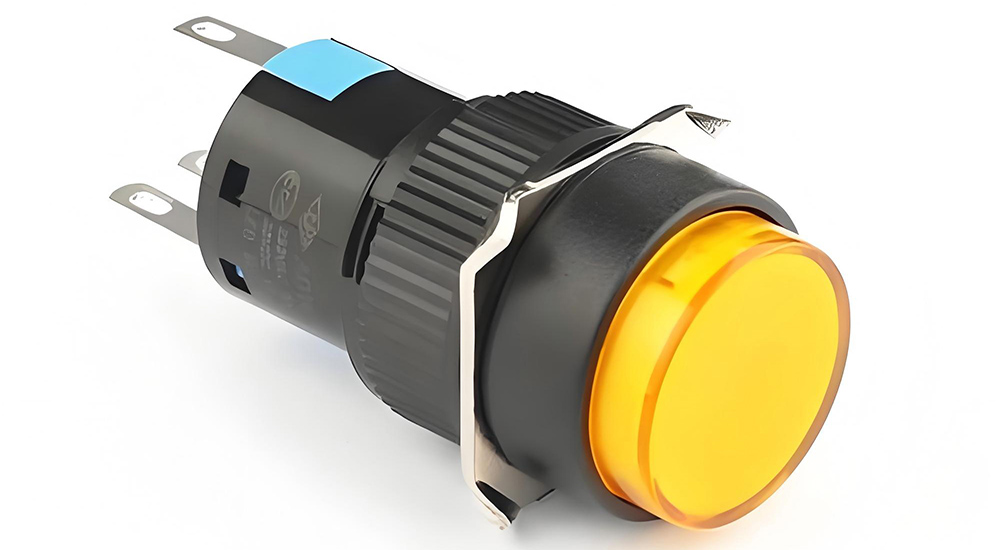
An illuminated push button has a built-in LED that lights the actuator either all the time or only when the button is pressed. Common LED voltages are 3V, 6V, 12V, and 24V. The LED can share a common ground with the switch contacts or be wired independently with its own pins.
Independent wiring gives more flexibility: you can light the LED red when the circuit is off and green when on, or pulse it to indicate a fault condition. Ring illumination lights a circle around the actuator. Dot illumination lights a single spot at the center.
Ring illumination is more visible from the side. Dot illumination is more visible straight on. Match the LED voltage to your control circuit. If the circuit voltage does not match, add a current-limiting resistor sized to the LED current rating and the voltage difference.
Waterproof Push Buttons and IP Ratings Explained
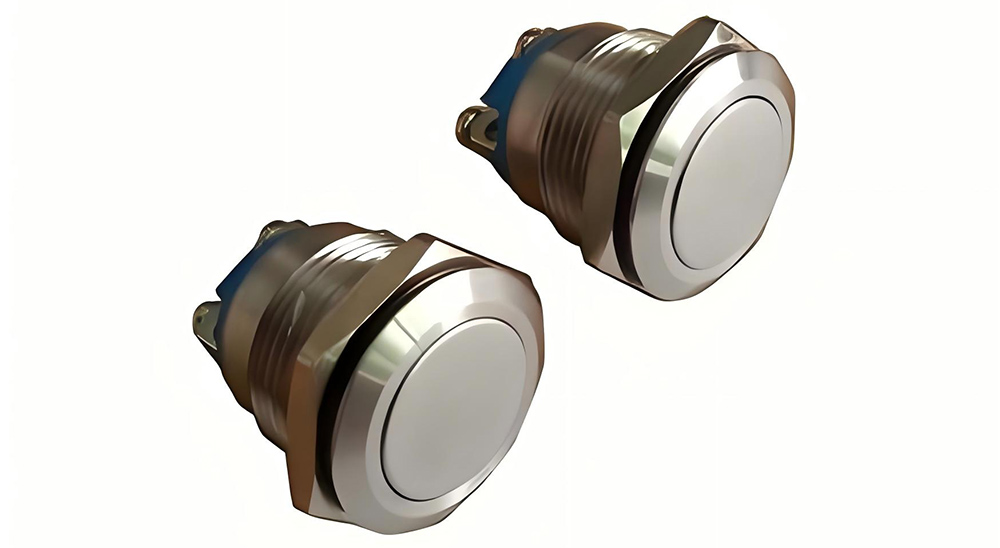
A standard push button has gaps around the actuator that let in dust and moisture. Sealed push buttons fill those gaps with O-rings, gaskets, and sealed bushings. An IP65 rating means the button is dust-tight and protected against low-pressure water jets from any direction. This is enough for outdoor kiosks that see rain but not submersion.
An IP67 rating means the button can sit in up to one meter of water for 30 minutes. IP68 means it can handle continuous submersion beyond one meter.
For marine, food processing, and outdoor industrial environments, choose IP67 or higher. The sealing also protects the internal contacts from humidity and condensation, which extends switch life even if the button never gets directly wet.
Housing Materials: Plastic, Stainless Steel, Nickel-Plated Brass
Plastic Bodies
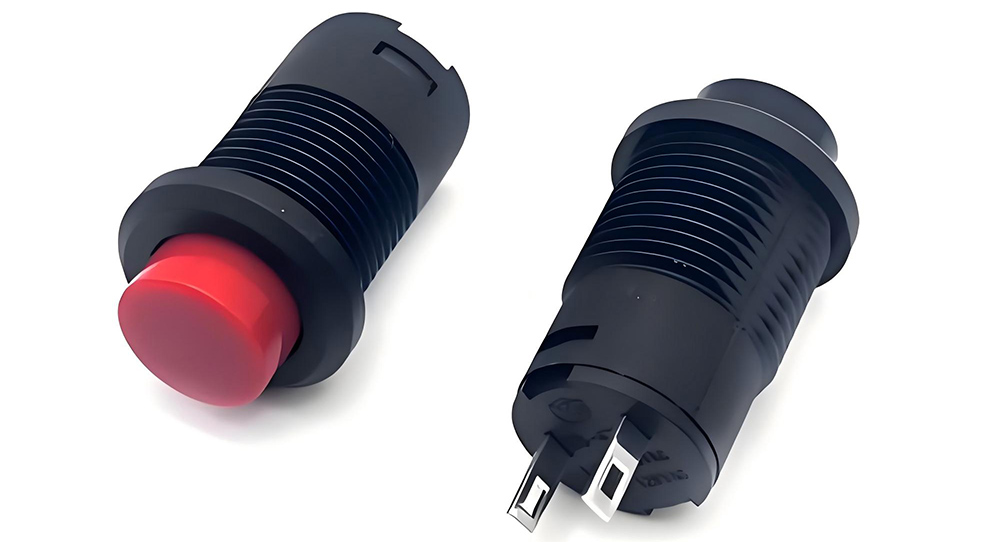
Plastic push buttons are the lightest and least expensive. They work well for indoor consumer electronics, office equipment, and dry industrial environments. The plastic can be nylon, polycarbonate, or ABS. Polycarbonate has better impact resistance. Nylon handles higher temperatures. Check the material data sheet if the switch will sit near a heat source.
Metal Bodies
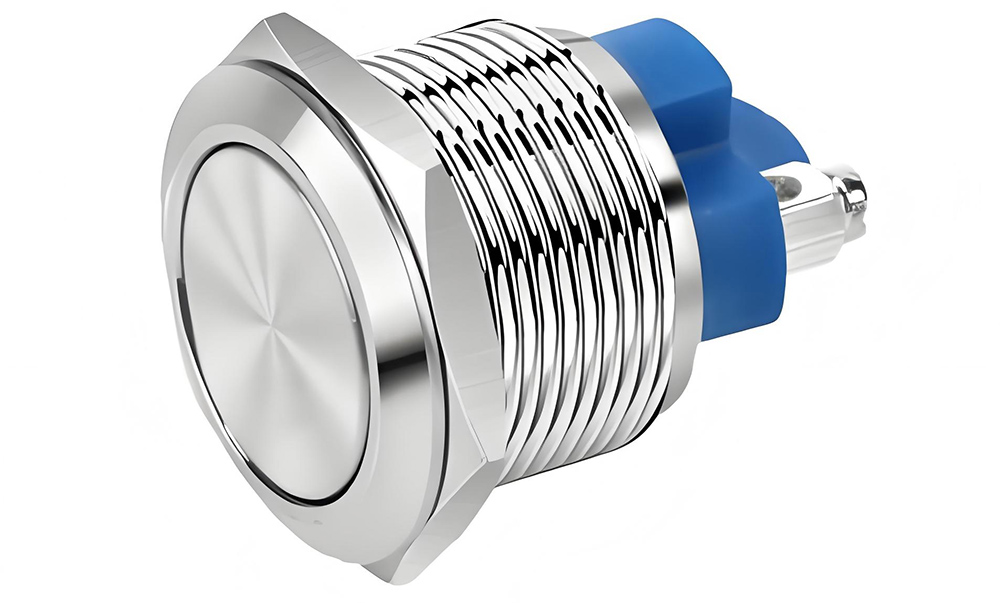
Stainless steel push buttons resist corrosion, handle wide temperature swings, and look clean after years of use. They are the standard for outdoor, marine, food processing, and medical equipment.
Nickel-plated brass costs less than stainless steel and still offers good corrosion resistance for indoor use. The plating can wear through at friction points over a long service life, so for outdoor or washdown applications, stainless steel is the safer choice.
Key Electrical Specifications to Check
Voltage and current ratings are the first specifications to check. A switch rated at 3A, 250VAC may be rated for only 0.5A at 30VDC. This difference is important because DC arcs do not naturally extinguish at a zero crossing, unlike AC arcs, which reduces the stress on the contacts.
For a new switch, contact resistance should typically be below 50mΩ. Insulation resistance between the terminals and the switch housing should be 100MΩ or higher to ensure reliable electrical isolation.
Service life is measured in two ways. Mechanical life refers to the number of operating cycles without an electrical load and generally ranges from 100,000 to more than 1 million cycles, depending on the switch design. Electrical life refers to the number of operating cycles under the rated load and is typically 50,000 to 200,000 cycles.
If your application requires a service life of 1 million cycles or more, reduce the operating current or choose a switch with a higher electrical life rating to achieve better long term reliability.
Common Applications Across Industries
Consumer electronics use miniature push buttons for power, reset, and mode selection on everything from remote controls to kitchen appliances. Industrial control panels use 22mm round push buttons with mushroom head emergency stops as the standard operator interface.
Automotive dashboards use illuminated push buttons for start/stop, drive mode selection, and auxiliary controls. Marine panels use IP67 stainless steel push buttons for bilge pumps, navigation lights, and horn controls.
Medical devices use sealed push buttons that can be cleaned with disinfectant between uses. Vending machines use push buttons for product selection. Elevator panels use illuminated round or square buttons with Braille markings on the face.
How to Select the Right Push Button Switch
Start with the Circuit Requirements
How many poles and throws? Most push buttons are SPST or SPDT. SPST is the simplest: two terminals, on or off. SPDT has three terminals and lets one input switch between two output paths. Next, pick momentary or latching. Then check the voltage and current. If the load is inductive, like a motor or solenoid, derate the current by 30 percent.
Then Match the Environment
- Indoor and dry: standard plastic or metal body.
- Outdoor or washdown: IP65 or IP67 sealed button with stainless steel body.
- High-vibration environment: threaded mounting with locking nut rather than snap-in clips.
- Public access: anti-vandal or mushroom head for durability.
- Clean room or medical: stainless steel body with smooth, flush surface for easy cleaning.
Browse Bituoelec push button switch options for a full range of sizes, materials, and IP ratings.
Installation and Wiring Guidelines
Panel Mounting
Threaded-body push buttons slide through the front of the panel and secure with a locking nut from behind. Hand-tighten first, then add a quarter turn with a wrench.
Over-tightening can crack a plastic bezel or distort the sealing O-ring on a waterproof button. Snap-in buttons just push into the cutout until the clips engage. They are faster to install but less secure in high-vibration environments.
Terminal Connections
Solder lugs work for low-volume assembly and prototypes. Quick-connect tabs are faster for production and easier for field replacement. The standard tab widths are 2.8mm, 4.8mm, and 6.3mm. Match your female crimp terminals to the tab width. Screw terminals are the easiest for field wiring where no special tools are available.
After connecting, tug each wire gently to confirm the terminal is secure. For illuminated buttons with independent LED pins, label each wire at both ends. The LED can be damaged if it receives the wrong polarity or voltage.
Bituoelec Push Button Switch Solutions
Bituoelec manufactures push button switches in 8mm to 30mm sizes with round, square, and mushroom head actuators. Options include momentary and latching action, illuminated and non-illuminated, plastic and stainless steel bodies, and IP65/IP67 sealing.
Custom actuator colors, LED configurations, laser engraving, and pre-wired harnesses are available through OEM and ODM services.
Frequently Asked Questions
Q What is the difference between momentary and latching push buttons?
A momentary button only stays active while you hold it down. Release it and the contacts return to their default state. A latching button stays in the pressed position until pressed again. Use momentary for doorbells, jog controls, and reset buttons. Use latching for power on/off switches.
Q Can I use a push button outdoors?
Only if it is IP65 or higher rated with a stainless steel or sealed plastic body. Standard indoor push buttons will fail quickly when exposed to rain, dust, or condensation. Make sure the rear wiring connections are also protected inside a sealed enclosure.
Q What size panel cutout do I need?
Common sizes are 8mm, 12mm, 16mm, 19mm, and 22mm in diameter. 16mm and 19mm are typical for consumer electronics and compact panels. 22mm is the standard for industrial control panels. Measure your panel thickness too: most threaded buttons handle 1mm to 6mm panels.
Q Why does my illuminated push button LED not light up?
Check the LED voltage matches your circuit. A 12V LED on a 5V circuit will not light. Check the polarity. LEDs are diodes and only conduct in one direction. Check the current-limiting resistor if you are using a voltage higher than the LED rating. Without a resistor, the LED can burn out instantly.
Q How long do push button switches last?
Mechanical life typically ranges from 100,000 to over 1 million cycles. Electrical life under load is shorter, often 50,000 to 200,000 cycles at full rated current. Derating the current extends electrical life.
Q Where can I order push button switches in bulk?
Bituoelec supplies push button switches in a range of sizes, materials, actuator styles, and IP ratings. OEM customization and bulk pricing are available. Contact us with your specifications.