


A microwave door knows when it is shut. A washing machine knows when the lid is closed. A vending machine knows when a product has dropped. All of these depend on a component most people never see: the micro switch.
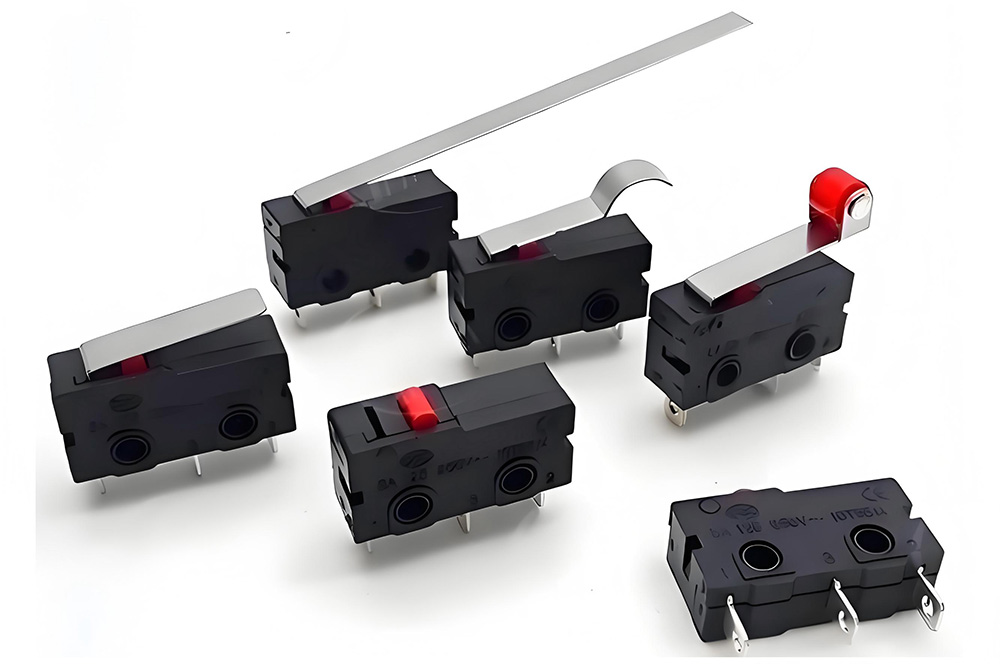
Bituoelec manufactures a wide range of micro switches for appliances, industrial equipment, and consumer electronics. This guide covers how they work, what types are available, and how to pick the right one.
What Is a Micro Switch and How Does the Snap-Action Mechanism Work
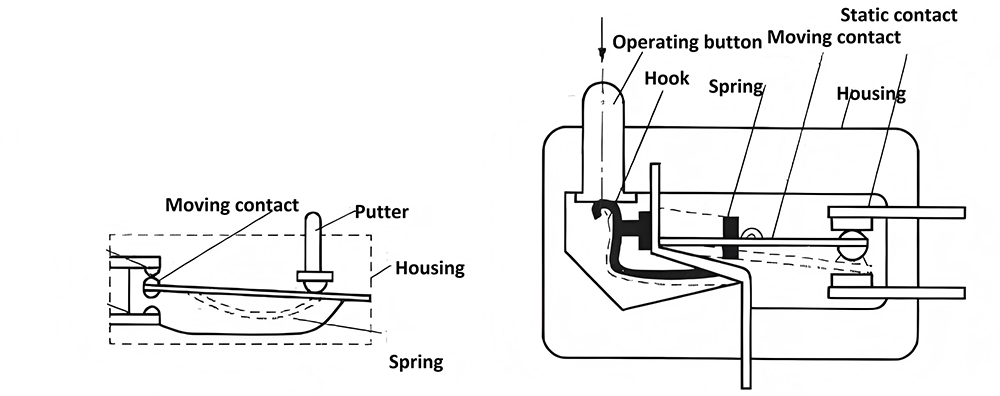
A micro switch, also called a snap-action switch or miniature snap-action switch, is an electric switch that actuates with very little physical force. The defining feature is the snap-action mechanism inside.
A spring-loaded contact moves between two fixed positions. When the actuator is pressed past a tipping point, the internal spring snaps the contact from one position to the other in a fraction of a second. There is no slow transition or partial contact. It is on or it is off.
Why Snap-Action Matters
That fast snap does two things. First, it reduces electrical arcing at the contacts because the circuit opens and closes quickly. Less arcing means less contact wear and a longer switch life.
Second, it gives the switch a predictable actuation point. A designer can count on the switch changing state at the same position every time, which matters for precision limit-switching in machinery.
Circuit Configurations: Understanding NO, NC, and COM
The Three Terminals
A standard micro switch has three terminals: COM (common), NO (normally open), and NC (normally closed). When the switch is at rest, COM connects to NC.
When the actuator is pressed, the internal spring snaps the contact over. COM disconnects from NC and connects to NO instead. Release the actuator and it snaps back to the rest state, reconnecting COM to NC.
SPDT and Practical Wiring
This three-terminal arrangement is called SPDT (single pole, double throw). It means one input can route to one of two outputs. In practice, many designs only use two of the three terminals.
Wire COM and NO if you want the circuit to close when the switch is pressed. Wire COM and NC if you want the circuit to open when the switch is pressed. Having all three gives the designer flexibility without changing the switch part number.
Actuator Types: Pin Plunger, Lever, Roller, and More
Pin Plunger
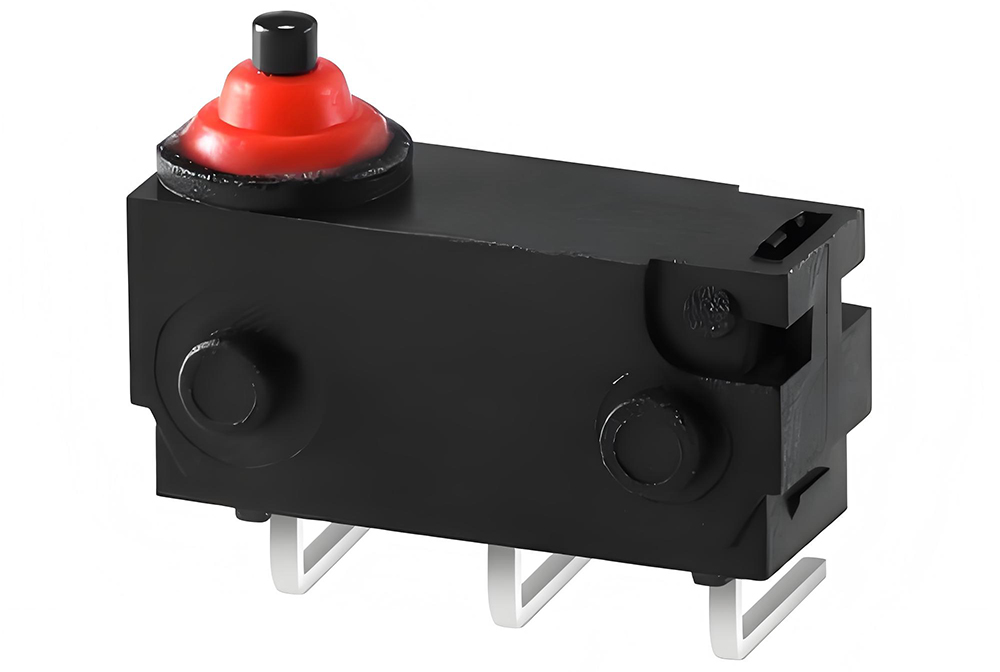
The simplest type. A straight post protrudes from the switch body and gets pressed directly. This works when the object that actuates the switch moves straight toward it. Typical use: a microwave door latch presses a pin plunger when the door closes.
Hinge Lever and Roller Lever
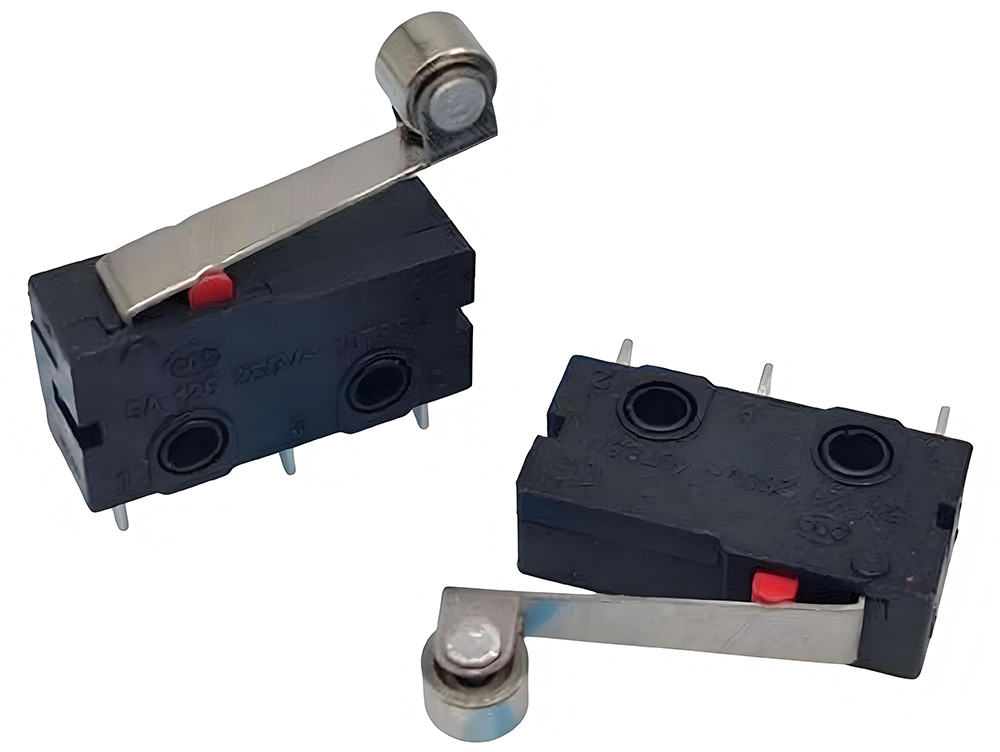
A hinge lever attaches a flat metal arm to the switch body. It amplifies the actuation point and reduces the force needed to trip the switch. A roller lever adds a small wheel at the tip of the lever. The wheel rolls along a cam or sliding surface instead of scraping against it. This is common in conveyor systems and automated machinery where a moving part sweeps past the switch.
Other Variants
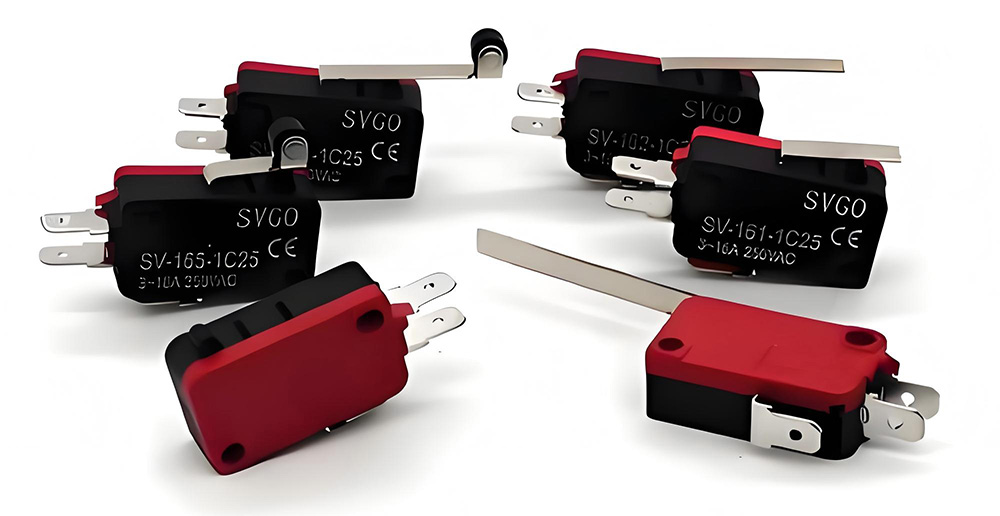
Simulated roller levers use a bent metal tab shaped like a roller without an actual wheel. They cost less and work where friction is not a concern. Leaf spring actuators use a flexible flat spring as the lever for very light force applications.
Wobble stick actuators, sometimes called cat whisker types, use a thin flexible rod that can be actuated from any direction. They suit applications where the exact direction of the triggering object is not predictable.
Key Electrical and Mechanical Specifications
Electrical Rating
Micro switches are rated by voltage and current. A common rating is 5A at 250VAC. The same switch may handle 10A at 125VAC but only 0.5A at 125VDC.
DC switching is harder on contacts than AC switching because DC arcs do not self-extinguish at the zero crossing point of the waveform. Always check the DC rating if your circuit runs on DC, even at low voltage.
Actuating Force and Travel
Operating force is how hard you need to press to trip the switch. Typical values range from 15 grams-force for subminiature switches up to 400 grams-force for heavy-duty industrial types.
Release force is lower than operating force because of the snap mechanism’s hysteresis. Overtravel is the extra distance the actuator can move after the switch trips. It provides a safety margin so that slight over-travel during real-world use does not damage the switch.
Mechanical and Electrical Life
Mechanical life is how many times the switch can be cycled with no electrical load. A quality micro switch might be rated for 1 million to 10 million mechanical cycles.
Electrical life is shorter because the contacts wear under load. At full rated current, electrical life might be 100,000 to 500,000 cycles. Check both numbers on the data sheet and design for the lower one.
Where Micro Switches Are Used
Home appliances are the largest market. Refrigerator door sensors, washing machine lid locks, microwave door interlocks, and rice cooker lid detection all use micro switches. Vending machines use them to detect when a product falls into the dispenser tray.
Industrial machinery uses them as limit switches to stop a linear actuator or conveyor at a defined position. Automotive applications include brake pedal position sensing, seatbelt buckle detection, and trunk lid status. Medical devices use sealed micro switches in infusion pumps and diagnostic equipment where liquid ingress is a concern.
Micro Switch vs. Limit Switch: What Is the Difference
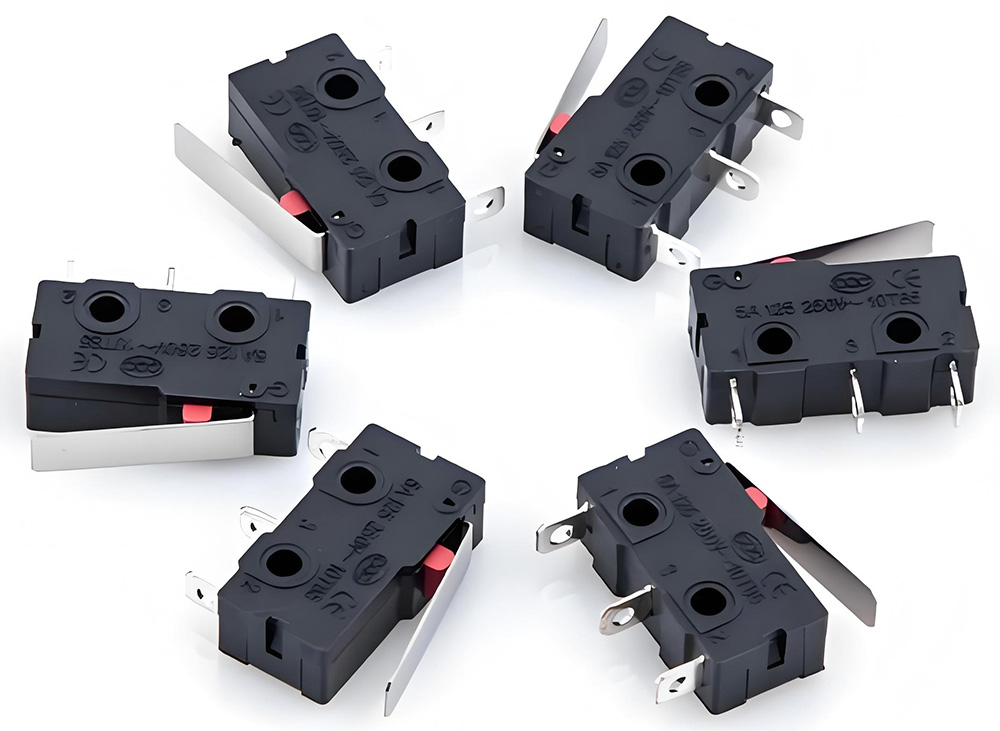
A limit switch is a broader category. It is any switch that detects the presence or position of an object by physical contact. A micro switch is one type of limit switch. The key difference is size and precision. Micro switches have smaller operating travel, tighter repeatability, and faster snap action.
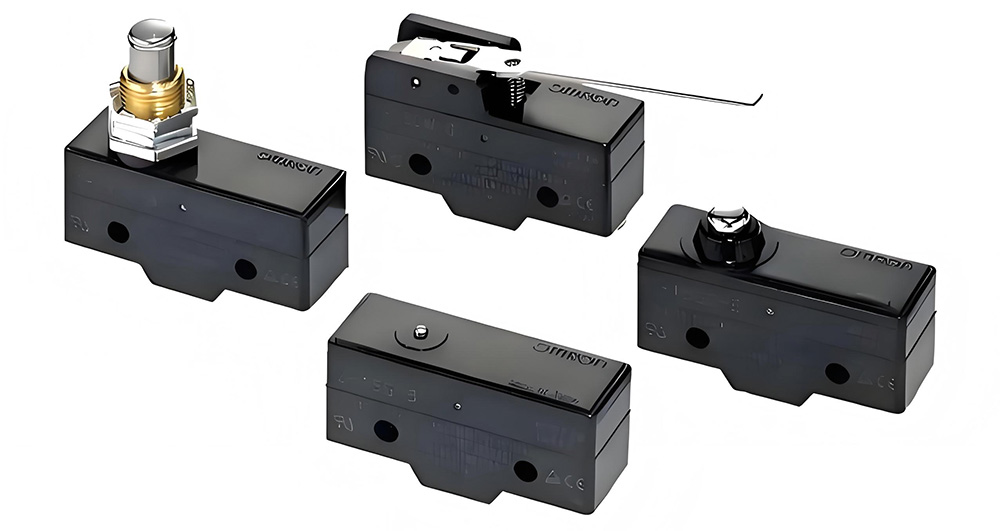
Standard industrial limit switches are larger, have longer travel, and handle higher currents. If you need to detect a cam position with sub-millimeter accuracy, use a micro switch. If you need to stop a heavy gate at the end of its travel and switch 20A, use a full-size limit switch.
How to Select the Right Micro Switch for Your Design
Start with the electrical requirements: voltage, current, AC or DC. Then check the actuator type and operating force. A hinge lever with a roller tip suits a cam-driven application. A pin plunger suits a direct push.
Next, choose the termination style: solder lugs for low-volume assembly, quick-connect tabs for faster wiring, or PCB pins for board mounting. Check the environmental conditions. If the switch could see splashing water, choose an IP-rated sealed version. If the operating temperature goes below freezing or above 85 degrees Celsius, verify the temperature rating on the data sheet.
Browse Bituoelec micro switch options to compare actuator types and electrical ratings side by side.
Installation and Wiring Guidelines
Actuator Alignment
Mount the switch so that the actuator is pushed along its intended axis. A hinge lever should be pressed perpendicular to its pivot line. A pin plunger should be pushed straight in, not at an angle.
Off-axis force shortens the switch life by wearing the internal bushing or bending the actuator. Leave some overtravel in the mechanism. The moving part should continue past the trip point by a few tenths of a millimeter. This margin keeps the switch from being pushed to its mechanical limit on every cycle.
Terminal Connections
Use the right terminal for your wiring method. Solder lugs need a clean joint with no cold solder. Quick-connect tabs need the matching female terminal size, typically 4.8mm or 6.3mm wide.
After connecting, tug the wire gently to confirm the terminal is secure. For field-replaceable installations where soldering is not practical, quick-connect is the better choice.
Maintenance and Troubleshooting Tips
Routine Inspection
Micro switches in clean, dry environments rarely fail before their rated life. In dusty or wet environments, check the switch body for cracks or seal degradation during scheduled maintenance. A cracked housing can let moisture reach the contacts.
Listen for the snap sound. A switch that no longer produces a crisp click may have a fatigued internal spring. It should be replaced before it fails intermittently.
Common Failure Modes
Contact welding is the most common failure when switching DC loads above the rating. The arc welds the contacts together and the switch stays closed permanently. This is a sign the switch is undersized for the load.
Actuator breakage happens when the switch is hit with more force or at a worse angle than intended. Adding a mechanical stop to limit the actuator travel prevents this. Intermittent operation often comes from loose terminal connections or oxidized contacts. Reseat the terminals or replace the switch.
Bituoelec Micro Switch Solutions
Bituoelec manufactures micro switches in standard, miniature, and subminiature sizes with a range of actuator styles, terminal options, and IP ratings. Every switch is tested for consistent actuation force and electrical performance. Custom actuator shapes, wire harnesses, and PCB-mount configurations are available through OEM and ODM services.
Browse micro switch products Browse micro switch products
Contact Bituoelec for a quote Contact Bituoelec for a quote
FAQ
Q What is the difference between NO and NC terminals?
NO (normally open) means the circuit is open when the switch is at rest and closes when the actuator is pressed. NC (normally closed) means the circuit is closed at rest and opens when pressed. Most micro switches have both, plus a COM terminal. You can use either pair depending on your circuit logic.
Q How long does a micro switch last?
Mechanical life typically ranges from 1 million to 10 million cycles. Electrical life under load is shorter, often 100,000 to 500,000 cycles at full rated current. The actual number depends on the electrical load, switching frequency, and environment.
Q Can I use a micro switch outdoors?
Standard micro switches are not sealed and will fail if exposed to rain or condensation. Choose an IP-rated sealed micro switch for outdoor use. Make sure the wiring connections are also protected from moisture.
Q What actuator type should I choose?
Pin plunger for a direct push along the axis of the switch. Hinge lever for lower operating force and cam-driven applications. Roller lever for sliding surfaces where friction matters. Wobble stick for actuation from unpredictable directions.
Q Why does my micro switch fail quickly?
The most common reasons are switching DC loads above the switch rating, off-axis actuator force, or exceeding the overtravel limit. Check your circuit current, actuator alignment, and mechanical stops.
Q Where can I order micro switches in bulk?
Bituoelec supplies micro switches in a range of actuator types, electrical ratings, and IP protection levels. Contact us for bulk pricing and OEM customization.